11.21.2014

Synergo


Over the past 2 weeks Synergo went from request to concept to prototype to an almost finished product!

It all started when it was suggested that we make a game little kids could play.  The thing is, we like to make the kind of games that we will play.  Which begged the question: could a game be both?

Within the span of a day, we had a rudimentary concept.  Within 48 hours we had a paper prototype.  Before the week was out, the first rule sheet was drafted.

And today, after several small refinements and a healthy dose of playtests, we're ready to order up our copy of the finished product.

What is Synergo?

11.10.2014

Skatepark Legends is here!


Just got my prototype in the mail!  Everything looks great, which means...

You can pick up your copy today!

And don't forget to download the papercraft patterns while you're there.


10.30.2014

Skatepark Legends Update

So... it's pretty much done!

Still looking the game over, making sure I didn't miss anything.  The manual may still need one or two tweaks.  Nevertheless, it has been officially submitted into the Game Crafter's Time Challenge contest.

I'll be ordering my prototype in the next few days, and when it arrives, I'll publish. (Then you can order yours!)

Also, I have updated the Papercraft models which you can download here.  I have to say they look pretty good, and even with cheap "multi-purpose" printer paper they are pretty durable.

10.02.2014

Prototyping Skatepark Legends

I have been working (whenever I can steal a free minute) on a new project for the Time Challenge contest on TheGameCrafter.

While not all of the features are fully realized yet, I am pleased to share a look at the current prototype. I think I would go as far as saying this probably marks the turn from alpha to beta.
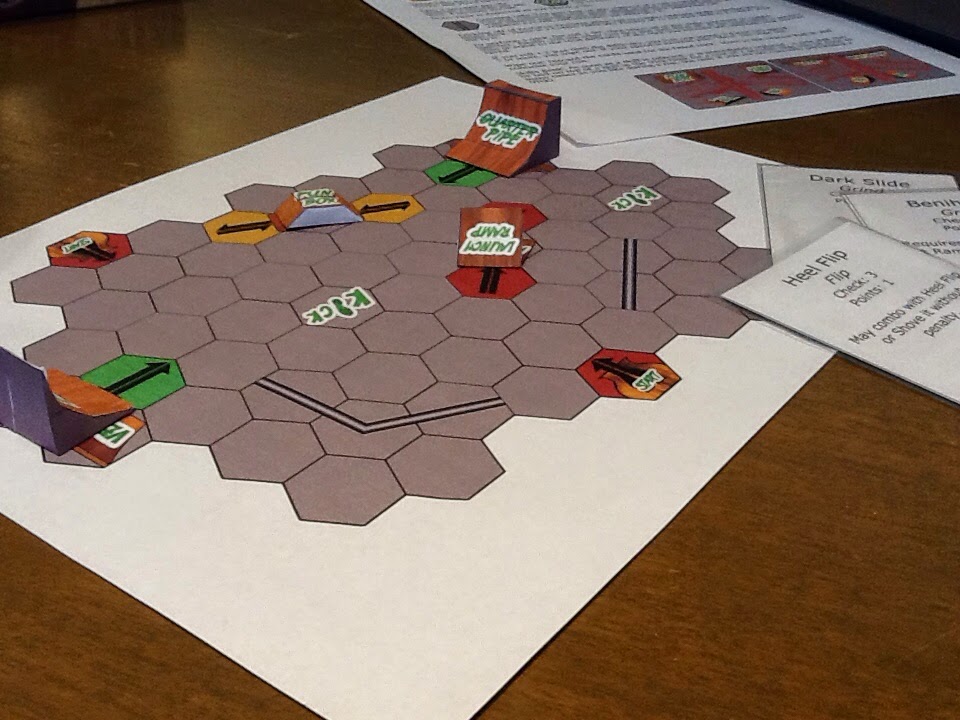
Prototype Board with Papercraft models!
The basic gameplay is a risk/reward mechanic, where players must manage their speed and movement efficiently, while still throwing down the most challenging tricks they think they can pull off.

Only one player is active at a time, and I may address that in a formalized way, but I want to see if the social component of the game (i.e. watching your friend's run, cheering them on, trying to talk them into risky tricks, etc.) are compelling enough to leave it alone. I suspect it might be... I hope so, honestly, because that keeps it more in line with the spirit of competitive skating.

As an aside: you'll notice I've included little "papercraft" models. They are purely ornamental, and do not change game play - but they sure make the board look cool. I plan on shipping the game with the templates in the box on nice glossy paper for folks to make their own.

I heard quite a bit of skepticism about papercraft components when I pitched the idea to some peers - principally because of how fragile they would be. But I designed them with durability in mind, and because of their small size, they've stood up pretty well so far.

And of course, downloads of the template will be available, so the models will be inexpensive to replace, if need be.

9.18.2014

The Valiant: a History

I have been developing The Valiant for a very long time.  In my mind I thought I'd been on it for a couple of years... but after talking to some of the folks who helped me playtest in the VERY early stages, it turns out I've been at it (off and on) for about 6 years.

With a development cycle that long, it's interesting to see how much it has changed over the years.

If you have any familiarity with The Valiant, you probably picture it as a card game.  But in its earliest infancy, it was actually a square grid, move-and-attack game.  This version of the game essentially had 4 effect types: Attacks, Reactions (defenses), Passives, and Fortune's Favor. While Reactions and Attacks have been folded into the broader "Abilities" category, you can see that the basic structure of the classes had already begun to form up.

In truth, that game was pretty fun, and I may revive it sometime soon -
albeit with some refinements and much needed beautification.

9.08.2014

8-Bit Royale - Beta rolls on

I played through the current beta of 8-Bit Royale at a local gaming group. Definitely needs some refinement. On the plus side, people seemed to really respond well to the art work. Also a plus, the drafting style of team building seems much better.


On the negative side: some pacing concerns, power balancing (which I expected), and currency imbalance need to be addressed. The overall effect was not a slam-dunk play experience.

A few tweaks to the rules about taking and spending coins will probably address the largest issues. Power balancing is still a little nebulous, though. We'll see how things change after the next rule revisions.


1.04.2010

Concrete versus Abstract

Philosophically, I find that there are many parallels between games and literature.  Some games are very explicit in their narrative (such as most role-playing games) while others are a bit more esoteric.  Chess, for example, has an implicit narrative, though it is not much explored in the scope of the game.  It is simply a given that kings war with one another, and the motivation therein is largely irrelevant.

The more abstract a game is, the more obscure the narrative... or the more non-fictional it becomes.  For example, poker seems to have no narrative at all, yet watching people play can be very engaging because the players themselves are the narrative.
Perhaps that approach is insufficient as well.  Perhaps it is not a linear gradation, but a planar one.  There are some games, such as "capture the flag" that have a concrete objective as well as a non-fictional narrative.

Below is a chart to illustrate the point.  As I was working on it, I had trouble coming up with anything for the extreme Fictional/Abstract spot.  Perhaps this is just a short-coming on my own part, but I think perhaps it is illustrative.

I was tempted to put immersive "sandbox" games (like WoW or Little Big Planet) in this spot, but I had to resist on these grounds: When the game becomes narrative (for instance, when the player in WoW gets involved in the plot), it does so to introduce concrete objectives.  This is most often done in the form of "quests," but - as in the case of WoW - an expansion may have a larger narrative, the concrete goal of which is usually to kill the "Boss" of that expansion.

LBP on the other hand, is in some sense, immersive, but it really occupies a spot between fictional and non-ficitional, because there is no real narrative that drives the game.  It is about the interaction of the player (as the player or even as a level designer) with the fictional sack-people.

What does this tell us?  I think that for a game to exist, people need cognitive anchors.  The more the game exists in "our world" the more abstract its goals can be.  However, a highly narrative without a concrete goal simply leaves the player saying, "Okay... so... now what?"

There is more to discuss about the value of "representation" in making cognitive anchors, which we will explore in later posts.